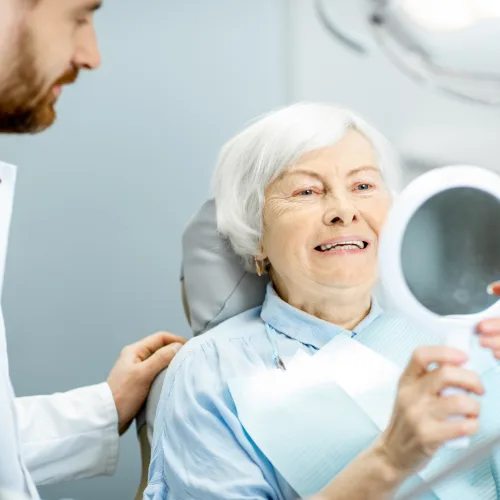
Dentures
Restore your smile and function with custom-crafted dentures
Restoring Your Confidence and Function with Dentures
Missing teeth affect not only your appearance but also your ability to eat, speak, and smile with confidence. Dentures are an excellent solution for people who have lost some or all of their natural teeth, providing a way to restore function and aesthetics. Modern dentures are more comfortable, natural-looking, and durable than ever before. At Lincoln Smiles Dental, Dr. Sepideh Rahmani crafts custom dentures that fit perfectly, look beautiful, and feel comfortable. Whether you need a full denture to replace all your teeth or a partial denture to fill in gaps, we can help you restore your smile.
Understanding Full and Partial Dentures
Full dentures replace all of your upper teeth, lower teeth, or both. A complete upper denture covers the palate and is held in place by suction and the natural saliva seal. A complete lower denture is U-shaped and sits on the ridge of bone left after tooth loss. Full dentures rest on and are supported by the bone ridge where your natural teeth once were. Because bone changes over time after tooth loss, full dentures may need adjustment as your body adjusts to the loss of teeth.
Partial dentures replace one or more missing teeth while preserving remaining natural teeth. A partial denture consists of replacement teeth attached to a base that's typically made of acrylic, metal, or a combination of both. Partial dentures are held in place by clasps that attach to adjacent natural teeth. Unlike full dentures, partial dentures help preserve remaining teeth and bone, making them an excellent option if you still have some healthy natural teeth.
Both full and partial dentures can be either conventional or immediate. Conventional dentures are made after teeth have been removed and the gum tissue has healed, which takes several months. Immediate dentures are made before tooth extraction and are placed immediately after extraction, reducing the time you spend without teeth. However, immediate dentures require more adjustments during the healing period as your tissues change shape.
Implant-Supported Dentures
Implant-supported dentures offer a superior alternative to traditional removable dentures. Instead of relying solely on the remaining bone ridge for retention, implant-supported dentures are anchored to dental implants surgically placed in the jawbone. This provides significantly better stability, retention, and chewing function compared to traditional dentures. Because the denture is anchored to implants, it doesn't move or shift during eating or speaking, which many people find much more comfortable and natural-feeling.
Implant-supported dentures also help preserve the jawbone. Traditional dentures actually accelerate bone loss over time because the bone atrophies without the stimulation of tooth roots. Implants provide that stimulation, helping to preserve bone structure and maintain your facial contours. Over time, this makes implant-supported dentures a better value than traditional dentures, despite the higher initial cost.
The number of implants needed varies depending on your situation. Some patients need just two or three implants to stabilize a full denture. Others benefit from more implants for even greater stability. Dr. Rahmani will evaluate your bone structure and discuss how many implants would provide the best results for your specific situation. While implant-supported dentures require surgery and a longer treatment timeline, many patients consider them the best investment in their long-term oral health and quality of life.
The Denture Process
Creating custom dentures is a detailed, multi-step process that typically takes several appointments over a few weeks. It begins with a comprehensive examination and consultation. Dr. Rahmani will assess your remaining teeth and bone structure, discuss your goals and expectations, and explain the denture process. She'll answer your questions and address any concerns you have about wearing dentures.
If you still have teeth that will be extracted, those are removed first. If dentures are being made for teeth that have already been extracted, we'll work with the bone structure present. We take detailed impressions of your upper jaw, lower jaw, and the relationship between them. These impressions must be precise to ensure your dentures fit properly and your bite is correct. We also determine your vertical dimension of occlusion, which affects how your dentures look and feel.
The impressions and measurements are sent to a specialized dental laboratory where technicians craft your dentures. Denture fabrication requires great skill and artistry. The technician chooses tooth shade and shape to match your facial features and create a natural appearance. The denture base is sculpted to contour smoothly to your tissues. The teeth are arranged in a precise pattern to ensure good bite alignment and natural aesthetics.
You'll return to our office for a try-in appointment where we check the fit, color, and shape of your dentures before they're finalized. This is your opportunity to see how your dentures will look and provide feedback. We can make adjustments to tooth position, shade, or shape before the final processing if needed. Once you approve the try-in dentures, they go back to the lab for final processing and polishing.
At your delivery appointment, Dr. Rahmani places your new dentures and makes any necessary adjustments for fit and comfort. She'll show you how to insert and remove them and will provide detailed care instructions. She'll explain proper cleaning and maintenance, discuss dietary adjustments, and provide tips for speaking and eating comfortably. You'll likely have follow-up appointments for adjustments as you get used to your dentures and as your tissues continue to change shape.
Adjusting to Dentures
Many people need time to adjust to wearing dentures. The first few weeks involve a learning curve as you develop new muscle patterns for holding and moving your dentures while eating and speaking. Your mouth may feel fuller than it did with natural teeth, and you may have increased salivation for the first few days. These sensations typically subside as you adapt. Speaking may feel unusual at first, but most people adjust within a few days to weeks.
Eating with dentures requires some adjustment. Start with soft foods cut into small pieces. As you become more comfortable, gradually return to a normal diet, though you may always need to avoid very hard, sticky, or extremely crunchy foods. Chew on both sides of your mouth simultaneously to maintain stability and prevent rocking. With time and practice, eating with dentures becomes second nature.
Some people experience minor sore spots where dentures rub on tissues. This is normal during the adjustment period. Let Dr. Rahmani know about any sore spots at your follow-up appointments, and she'll adjust your dentures to eliminate the irritation. It may take a few visits to get everything perfectly adjusted, but we're committed to ensuring your dentures are comfortable.
Caring for Your Dentures
Proper care extends the life of your dentures and keeps them looking beautiful. Remove your dentures after meals and rinse them with water to remove loose food particles. Each evening, soak them in denture cleaner solution to remove stains and bacteria. Clean your dentures gently with a soft denture brush, avoiding harsh scrubbing that could damage the acrylic. Never use regular toothpaste or abrasive cleaners on dentures, as these can damage the surface.
When not wearing your dentures, store them in a container of water or denture solution. Dentures can warp if they dry out. Avoid exposing dentures to extreme heat, which can cause warping or damage. If your dentures become broken, cracked, or loose, contact us for repair. Don't attempt to repair them yourself, as DIY repairs can cause more damage. We can usually repair most problems quickly.
Continue to care for your remaining natural teeth if you're wearing partial dentures. Brush and floss daily and visit us regularly for professional cleanings. Continue to care for your gums and oral tissues even if you're wearing full dentures. Brush your palate, tongue, and cheeks gently with a soft toothbrush to remove plaque and bacteria. See us regularly for denture adjustments and to monitor your oral health as your tissues change over time.
Modern Advances in Denture Technology
Denture technology has advanced significantly in recent years, resulting in dentures that are more comfortable, durable, and natural-looking than ever. Modern denture materials are stronger than older acrylic materials, yet still lightweight and comfortable. Advanced shading and characterization techniques make modern dentures look remarkably like natural teeth, with subtle color variations and surface details that create a more lifelike appearance.
3D imaging and computer-aided design are now used in some denture fabrication processes, allowing for more precise fit and better initial comfort. Some dentures feature enhanced grip and retention properties that improve stability without adhesives. Implant technology has advanced to make implant-supported dentures a practical option for more patients. Flexible denture bases and hybrid denture designs offer alternatives to traditional acrylic that some patients prefer.
Dr. Rahmani stays current with these advances and incorporates the latest technology into her denture fabrication process. She works with the finest dental laboratories to ensure your dentures represent the best in modern denture design and craftsmanship.
Dentures versus Implants: Understanding Your Options
Both dentures and dental implants can restore function and aesthetics after tooth loss, but they have different advantages and limitations. Dental implants look and function most like natural teeth. They provide superior chewing function and preserve bone structure. They're a permanent solution that doesn't require removal for cleaning. However, implants require surgery, take time to integrate with bone, and are more expensive upfront. Not all patients are candidates for implants due to insufficient bone or medical conditions.
Dentures are less invasive and require no surgery. They're typically less expensive than implants. Dentures can be adjusted and replaced more easily than implants if your needs or preferences change. However, dentures require removal and cleaning, may affect taste and speech initially, and don't preserve bone as effectively as implants. Eating with dentures requires some adjustment and may be less comfortable than with implants.
The best solution depends on your individual situation. Some patients benefit from a combination approach, such as implant-supported dentures that provide the stability of implants with the adjustability of dentures. Dr. Rahmani will discuss all your options and help you choose the approach that best meets your needs, preferences, and budget.
Why Choose Lincoln Smiles Dental for Your Dentures
Dr. Sepideh Rahmani brings extensive experience in designing and fitting dentures. She combines technical precision with artistic sensibility to create dentures that not only fit perfectly but also enhance your natural appearance. She takes time to understand your goals and expectations, ensuring your dentures meet your needs.
We work with the finest dental laboratories that share our commitment to quality and craftsmanship. We provide comprehensive follow-up care and adjustments to ensure your dentures remain comfortable and functional. We're here to support you throughout your adjustment period and beyond, ensuring your dentures serve you well for years to come. Our goal is to restore not just your smile, but your confidence and your quality of life.
Related Services
Ready to Restore Your Smile?
Whether you need full dentures, partial dentures, or implant-supported dentures, Dr. Rahmani can help. Schedule a consultation today to discuss your options.