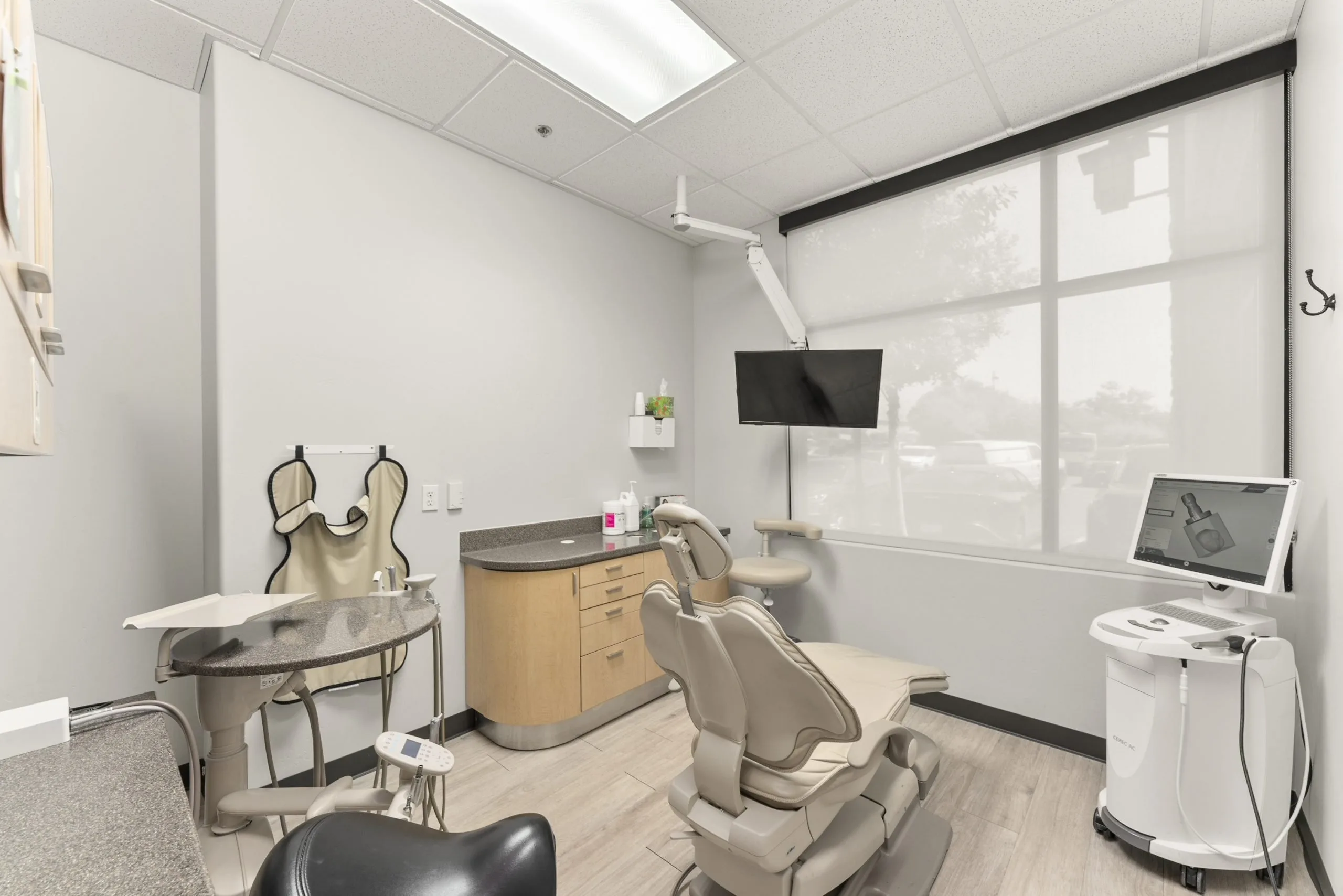
Digital X-Rays
Modern imaging technology for better diagnostics and lower radiation exposure
Advanced Technology for Accurate Diagnosis
Digital X-rays are an essential tool in modern dentistry, allowing us to see problems beneath the surface of your teeth and gums that aren't visible to the naked eye. At Lincoln Smiles Dental, we use advanced digital X-ray technology that produces high-quality, detailed images while exposing you to minimal radiation. This technology allows Dr. Sepideh Rahmani to diagnose problems early when they're easiest to treat, helping you maintain optimal dental health with fewer complications and less invasive treatment.
Understanding Dental X-Rays
Dental X-rays work through the same basic principle as medical X-rays. X-rays are a form of electromagnetic radiation that passes through soft tissues like gums but is absorbed by denser materials like bone and teeth. When X-rays are directed at your teeth, they pass through soft tissues but are partially blocked by your teeth and bone. A detector on the other side of your teeth captures the pattern of X-rays that pass through, creating an image that shows the density differences in your mouth.
In traditional film X-rays, this image is captured on photographic film. In digital X-rays, an electronic sensor captures the image and transfers it to a computer. Digital X-rays have several major advantages over film: they produce images almost instantly, they use significantly less radiation, they can be easily enhanced or adjusted if needed, and they can be stored electronically and easily shared with specialists or insurance companies.
X-rays allow us to see between teeth where decay is often hidden. They reveal bone loss caused by gum disease. They show the condition of tooth roots, the supporting bone, and the periodontal ligaments. They can detect infections, cysts, and other pathology. X-rays are essential for planning orthodontic treatment, placing implants, or performing any complex dental procedure. Without X-rays, we would miss many problems that could have serious consequences if left untreated.
Types of Dental X-Rays
Intraoral X-rays are taken with the X-ray sensor placed inside your mouth. These provide highly detailed images of individual teeth or small sections of your mouth. Periapical X-rays show the entire length of a tooth including its roots and the bone surrounding the tooth roots. Bitewings X-rays are taken with the sensor held between the upper and lower teeth and show the crowns of the teeth and the bone between them. Occlusal X-rays show a larger area of either the upper or lower jaw and are useful for checking overall tooth alignment and bone levels.
Extraoral X-rays are taken with the X-ray source and sensor outside your mouth. A panoramic X-ray, the most common extraoral X-ray, shows all your teeth and your entire jaw on a single image. Panoramic X-rays are useful for checking overall tooth development, identifying impacted teeth, and assessing bone structure. A panoramic X-ray takes just a few seconds to capture and exposes you to very minimal radiation, making it an efficient way to get a complete overview of your teeth and jaws.
Cone beam CT (CBCT) scans are advanced three-dimensional imaging technology that provides multiple cross-sectional views of your jaw and teeth. CBCT scans are particularly useful for complex cases like implant placement, orthodontics, impacted teeth, or when significant pathology is suspected. While CBCT exposes you to more radiation than simple X-rays, it still uses significantly less radiation than medical CT scans and provides superior diagnostic information for complex cases.
Advantages of Digital X-Rays
Digital X-rays offer numerous advantages over traditional film X-rays. They produce images instantly, allowing Dr. Rahmani to review them and discuss findings with you immediately during your appointment rather than waiting for film to be developed. The images are displayed on a computer screen and can be enlarged, made brighter or darker, or otherwise enhanced to bring out specific details. If an image isn't quite right, we can retake it quickly without waiting for another film to develop.
Digital X-rays use approximately eighty to ninety percent less radiation compared to traditional film X-rays. This is a significant advantage, particularly for children and patients who need multiple X-rays. Despite the lower radiation dose, digital images are often sharper and more detailed than film images. We can filter out unnecessary radiation frequencies, directing only the wavelengths needed for imaging at your teeth and jaw.
Digital images are stored electronically, taking up no physical space and never being lost or misplaced. When you request records from your current dentist to send to a new dentist, your X-rays are instantly available and can be transmitted electronically. If you ever need your images reviewed by a specialist, they can be sent immediately. This easy transferability improves care coordination and reduces duplication of X-rays.
Digital X-rays are also more environmentally friendly than film X-rays. There's no chemical processing involved, so no harsh chemicals are released into the environment. There's no film to dispose of. The paperless approach reduces our practice's environmental footprint.
Radiation Safety and X-Ray Guidelines
One of the most common concerns patients have about X-rays is radiation exposure. While it's true that X-rays involve radiation, the amount of radiation used in dental X-rays is extremely small. A single dental X-ray exposes you to less radiation than you receive from natural background radiation in your environment over several days. The radiation dose from a full mouth set of X-rays is equivalent to the radiation you naturally receive from the environment in a few weeks.
We follow the principle of ALARA: As Low As Reasonably Achievable. We take X-rays only when clinically necessary for diagnosis or treatment planning. We don't take routine X-rays if there's no clinical indication. When we do take X-rays, we use lead aprons or thyroid collars to protect your body from any incidental radiation. We use the fastest sensors and shortest exposure times possible to minimize your dose.
The American Dental Association recommends X-rays at intervals depending on your individual risk factors and clinical situation. New patients typically need a full mouth set of X-rays to establish a baseline. Patients at low risk for decay may only need X-rays every two to three years, while those at higher risk may benefit from X-rays annually. Children typically need X-rays more frequently because we're monitoring the development of their teeth and we want to detect decay early.
The benefit of detecting problems early through X-rays far outweighs the small radiation risk. A cavity detected early by X-ray may need just a simple filling. The same cavity left undetected may progress to require a root canal, crown, or extraction, and may cause significant pain. The radiation benefit to detecting these problems early is substantial.
What Digital X-Rays Can Detect
Digital X-rays allow us to detect many problems that would be impossible to find by visual examination alone. Decay between teeth, where a toothbrush can't reach, is easily visible on X-rays but often hidden from sight. Decay under existing fillings or crowns can be detected by X-rays before it causes pain or damage. Early decay inside a tooth, before it has progressed far enough to cause a cavity, shows up on X-rays.
Bone loss caused by gum disease is visible on X-rays as a decrease in the level of bone around the tooth roots. We can track bone loss over time by comparing X-rays from different years. X-rays reveal tooth roots and their shape, which is important information before extraction or for planning implant placement. Impacted teeth, including wisdom teeth that haven't erupted, are easily visualized on X-rays. Infections or abscesses at tooth roots show as dark areas around the root tips.
Developmental abnormalities of teeth can be detected on X-rays, including missing teeth, extra teeth, or teeth with unusual shapes. Cysts or tumors in the jaw appear as areas of abnormal bone density. Foreign objects like metal fragments in soft tissues are visible on X-rays. Jaw fractures can be detected and monitored with X-rays.
In pediatric patients, X-rays show the development of permanent teeth and help us predict when teeth will erupt. In orthodontic patients, X-rays help us plan treatment and monitor tooth movement. In implant patients, X-rays show us the bone structure and help us plan implant placement. X-rays are essential for successful complex dental treatment.
The Digital X-Ray Process
Taking a digital X-ray is a simple, quick procedure. For intraoral X-rays, we place a small sensor in your mouth and position it near the tooth or area we want to image. We may use a holder to position the sensor precisely. We position the X-ray tube on the outside of your mouth and aim it at the sensor. When everything is positioned correctly, we take the X-ray by pressing a button, which delivers a very brief burst of radiation. The entire process takes just a few seconds.
You may feel the sensor is uncomfortable because it's rigid and takes up space in your mouth, but it doesn't hurt. If you have a sensitive gag reflex, tell us and we can work slowly and position things in ways that minimize gagging. Some people find that taking slow, deep breaths helps them tolerate the X-ray sensor more comfortably.
For panoramic X-rays, the process is even simpler. You stand or sit in front of the panoramic X-ray machine with your chin resting on a chin rest. The machine rotates around your head while taking the X-ray. The entire process takes about ten seconds and you don't need to open your mouth wide or have anything placed inside your mouth.
For CBCT scans, you stand or sit in the scanner. The machine rotates around your head, taking many images from different angles. The process takes about one minute. CBCT is painless and no radiation or contrast is injected into your body.
Digital X-Rays and Your Concerns
If you're pregnant or think you might be, tell us before X-rays are taken. While dental X-rays use minimal radiation and are considered safe, we typically avoid X-rays during the first trimester of pregnancy out of an abundance of caution. If you have a dental emergency requiring X-rays and you're pregnant, your dentist can take them using extra precautions. The risk from avoiding necessary X-rays and missing a serious problem is often greater than the risk from the X-rays themselves.
If you have metal in your mouth like braces or metal implants, this typically doesn't prevent X-rays from being taken, though it may create some artifacts on the image. Tell Dr. Rahmani about any metal in your mouth so she can compensate for it when interpreting images. If you've received radiation therapy for cancer, tell us about your radiation treatments. We consider your total radiation exposure when deciding whether to take new X-rays.
If you're very anxious about radiation, discuss your concerns with Dr. Rahmani. She can explain exactly which X-rays you need and why. She can discuss the risks and benefits of taking X-rays versus the risks of missing a dental problem. Together you can decide on an X-ray schedule that you're comfortable with.
Why Choose Lincoln Smiles Dental for Digital Imaging
Lincoln Smiles Dental uses state-of-the-art digital X-ray technology. Our equipment is well-maintained and calibrated to ensure images are clear and properly exposed. Dr. Rahmani is experienced at taking X-rays and positioning them precisely to capture the images we need. She's skilled at interpreting X-rays and identifying problems that many general dentists might miss.
We believe in using technology appropriately to improve diagnosis and care. We take X-rays only when they're clinically indicated and we use the lowest radiation dose possible. We explain to patients exactly which X-rays we're taking and why. We encourage you to ask questions about your X-rays and to discuss any concerns about radiation exposure. Our goal is to provide you with excellent diagnostic information while keeping your radiation exposure minimal.
Related Services
Schedule Your Comprehensive Dental Exam
Digital X-rays help us detect problems early and provide you with the best possible care. Schedule an appointment with Dr. Rahmani today.